Showing posts with label TestBash. Show all posts

Tuesday, 25 October 2016

TestBash Manchester 2016

Introduction

Last week was awesome! Why? Because it was time for TestBash again, but this time in my hometown of Manchester! I was really looking forward to seeing familiar faces again, meeting new ones and learning a ton about testing again, especially in very familiar surroundings (my current workplace is barely 10 minutes walk away from the main conference!).

Pre-TestBash meetup

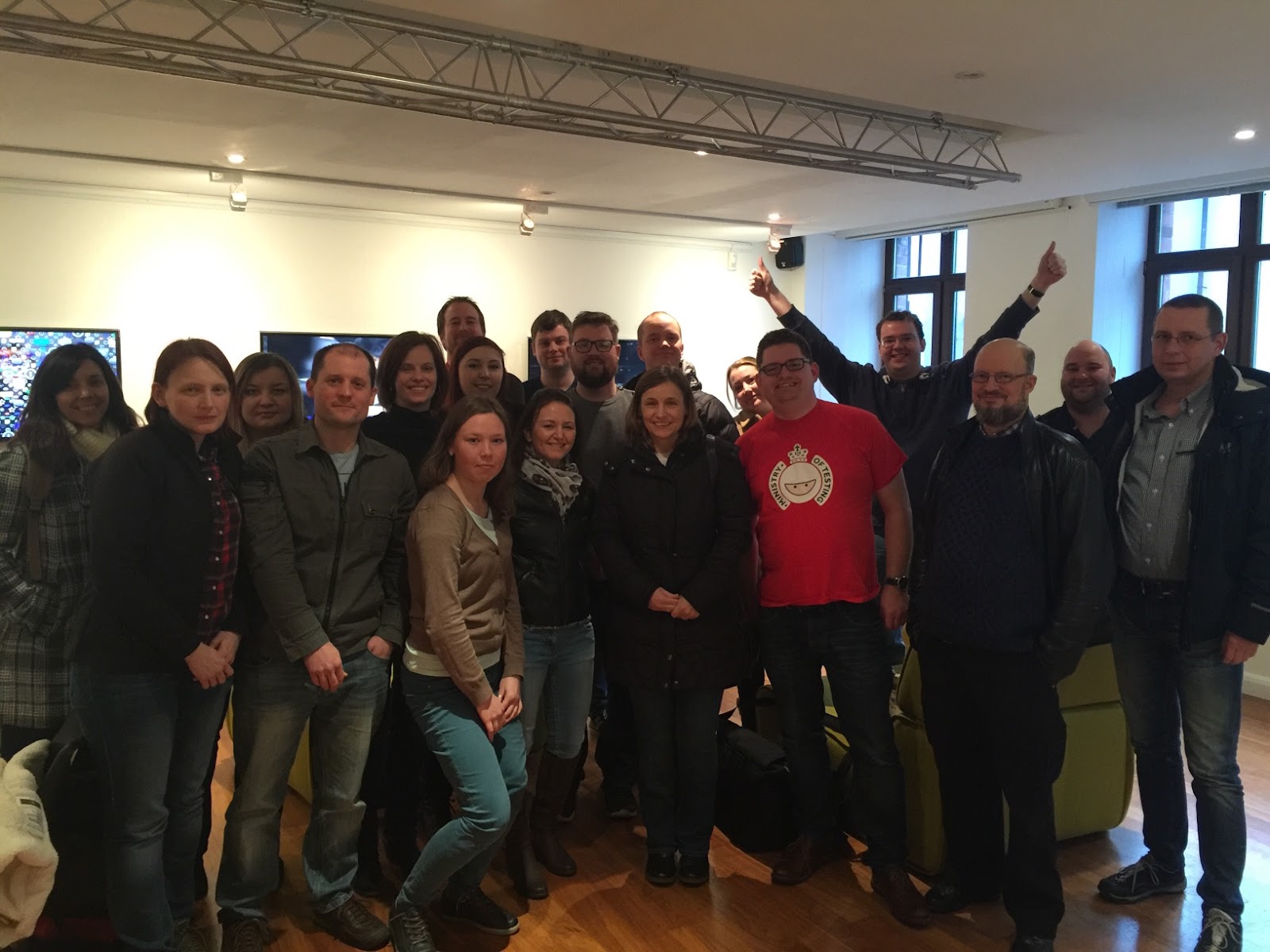
If you’ve never been to a TestBash before, one of the best parts of it is the socialising before and after. Usually there is a meetup hosted on meetup.com by Software Testing Club on the night before the main conference day. This is your opportunity to meet fellow attendees, speakers and even say hi to the organisers Rosie and Richard. I fully recommend that you attend this and meet people you’ve never spoken to before, we’re a friendly bunch and have plenty of stories to share!
At Manchester, one of the major sponsors, RentalCars, hosted the meetup in their very impressive offices in the centre of Manchester. I’m definitely a little bit jealous of their very unique beach-themed cafeteria!

Main Conference day

The next day was the main conference day at the Lowry Theatre in Salford Quays, I was unfortunately a little late and just missed out on getting involved with one of the Lean Coffee sessions but in the end it was ok because I could meet the rest of my team from work (who had fortunately been given budget to come along too!).
The talks for this TestBash definitely had a common theme which I would summarise as “psychology and learning”. The first five talks definitely followed a theme of psychology, starting with James Bach’s talk on critical and social distance.

The talks
I was really looking forward to James’ talk partly because his previous talks inspired me to start this blog and get more involved with the community to begin with, but also because the topic is close to my heart as my career has been driven by it. When I started as a games tester, I was effectively working as an offshore QA with pretty poor and slow communication channels with developers. Since then I’ve been driven to reduce social distance and prove that I can maintain critical distance even if I become very intimate with the software I test. James’ talk pretty much covered this and provided some useful language and framing to explain it. As always I learn so much from observing James’ style of talking too!

Following on from James were two talks from opposite ends of conversations - Iain Bright on the psychology of asking questions and Stephen Mounsey on listening. I took plenty of notes for these talks because I know I’d like to improve in both of these areas. I was actually on a little bit of a personal mission try and hold back my excitement and listen carefully to other testers during the event because I’ve felt I’ve talked too much before. Trying to carefully think about the questions you want to ask, and why you’re asking them was the main takeaway I took from Iain’s talk and Stephen’s made me aware of how often I’m thinking about people’s words (and my own response) rather than actually listening to what they have to say before they’re finished. Personally there was plenty of food for thought here that I’d like to try and slow down and keep in mind in future.

Speaking of slowing down and keeping in mind, I loved Kim Knup’s talk on positivity! I think every tester out there has felt they are negative to some degree, simply due to the nature of reporting problems. I definitely catch myself complaining a lot when things aren’t going great so I’m going to try and take onboard her ideas such as making notes of 3 positive things each day, to try and train my brain to look out for them. I’ve already started trying to high-5 people in the office to put a smile on my face haha.

Just before lunch, Duncan Nisbet gave a talk on “shifting left” called “Testers be more Salmon!”. I was looking forward to this as I know Duncan from NWEWT and from the Liverpool Tester Gathering. The topic itself is something that I’ve also been trying to encourage at work and my colleague Greg Farrow has written about it before on this blog. Essentially the idea is to test earlier, asking questions about requirements, testability and gathering information to both save time and catch bugs when it’s cheapest to do so. Duncan made the great point too that shared documentation doesn’t mean shared understanding, simply because something is documented, it doesn’t mean everyone understands it the same way.

I feel the afternoon talks had a theme running through about learning, starting with Helena Jeret-Mäe and Joep Schuurkes’ talk on “the 4 hour tester experiment”. This was a little bit of an explanation of an experiment they’d like to try based on Tim Ferriss’ 4 hour chef book. The idea is to try and see if you can train a tester in 4 hours, focusing on just the basics. I’d definitely encourage you to have a go at this challenge on their website fourhourtester.net. They talked a little about their opinion that testing isn’t something you can just teach, that it is much better to learn through practice and I fully agree with this, especially the analogy about learning to drive a car!

Following Helena and Joep was Mark Winteringham’s talk on the deadly sins of acceptance criteria. To be honest, I was looking forward to Mark speaking because he gave a great talk at the Liverpool Tester Gathering on testing APIs but I think I’m a little bored of hearing about the pitfalls of BDD now (Behaviour Driven Development). That’s not to take anything away from Mark’s talk, he shared some pretty familiar examples on what not to do and had a great way with humour in his talks. But the negativity around BDD or acceptance scenarios feels like the negativity I’ve encountered around Microservices and I’d like to hear some well-thought out, positive experience reports. It feels like all of the balanced or thoughtful talks tend to be quite negative really and I don’t really see a great deal of value in using BDD over more straight-forward approaches such as TDD (Test Driven Development) and just trying to encourage collaboration without the reliance on process to force it. I want to really emphasise that Mark gave a great talk though and I’m sure others who actively use BDD took a lot away from it! I don’t mean to imply here that Mark’s talk wasn’t well-thought out or negative about BDD, just my own feelings on the subject make me want hear more on the benefits.

Next was Huib Schoots with his talk on the “path to awesomeness” which was effectively a series of lists of great attributes for testers, areas to focus on to improve and generally just what he feels makes a great tester. Echoing the sentiments of Helena and Joep’s talk, he really emphasised the need to practice, practice, practice! One particular line he gave that I really liked was “testing is a psychological and social problem as well as a technical one”.

Gwen Diagram followed Huib with her talk on “Is live causing your test problems?”. If Duncan’s talk was about “shifting left”, then Gwen’s talk was about “shifting right” - she gave lots of great advice and ideas on how to “test in live” such as caring about and learning from your production logs and monitoring or using feature flags. Her talk was very on point for me after I recently attended a meetup on Microservices and I’ve very much got DevOps on my mind at the moment, so I was very appreciative when she came along to chat about it at the Open Space the next day too!

Finishing the day was Beren Van Daele with his experience report on trying to make testing visible on a project that he was a test consultant on. Any talk that includes a slide which reads “My Mistakes” is always going to be very valuable, it’s important to share our mistakes and how we learnt from them and Beren shared a lot! I loved his idea of taking the step of actually creating a physical wall of bugs (out of insect pictures) to get people to recognise the bugs that needed fixing.

Overall the talks were excellent, I made lots of notes and ended the day with the now familiar headache from trying to stuff so much into my brain. My colleagues seemed to enjoy and learn a lot too so all in all I was very happy.

99 second talks
So at the end of the conference, they usually have a section for 99 second talks open for anyone attending to stand up on stage and talk about anything they like. I intentionally decided not to do one this time because I wanted to focus on the main talks and not worry about what I was going to say later as I did in Brighton. I also wanted to save the topic I had in my head for the following day at the Open Space.
Those that did do one though, were great, especially a developer looking for a tester hug and Gem Hill’s on meditation and mindfulness. Not many people broke the 99 second limit though!

Post-conference meetup
So as with the pre-conference meetup, there’s usually a meetup after the conference at a nearby bar or pub. For Manchester this was Craftbrew which was barely 30 seconds walk away from the Lowry. Again, I fully recommend attending these as it gives you more time to chat to other attendees, especially as many only attend the conference day. Everyone seemed to have enjoyed the day and were all bubbling with ideas from the talks.

Open Space

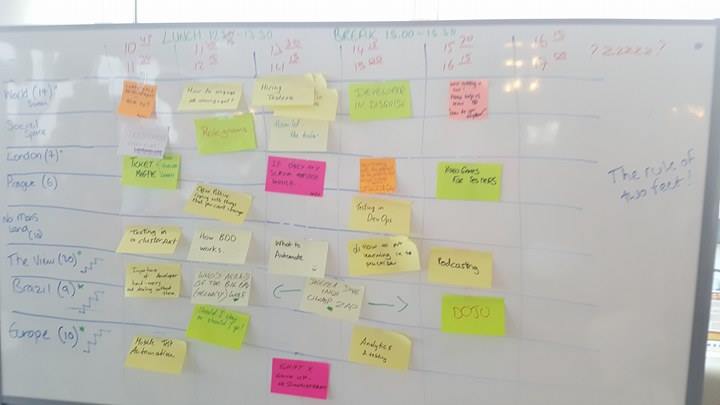
So for the first time TestBash held an “Open Space” day on the Saturday after the conference. This was held at LateRooms’ offices in the centre of Manchester (also very impressive offices that I’m jealous of, especially the number of great meeting rooms!). I had never been to one of these before and I was keen to try it out. If you’ve never been to one, it’s basically a conference where there is no formal plan, all of the attendees come up with talks, workshops or discussions they’d like to offer and everyone arranges a multi-track schedule that makes sense. I had no idea what to expect before I went but I knew I would get something useful out of it, and it definitely did!
openspace.jpg

To give you an idea, some of the things that were on the schedule were a workshop on security testing using Dan Billing’s insecure app called Ticket Magpie, a workshop on OWASP’s ZAP tool and in-depth discussions on BDD, automation and how to help new testers.

As I said before, I had a topic in mind that I wanted to discuss more with people so I ran a discussion on “Testing in DevOps”. I explained my feelings on the topic and openly asked what people felt about it and where they felt testing was going. I got a lot of great notes, ideas and thoughts out of this discussion and I’ll definitely be writing up a post about it in future! I’m very keen to talk about it at a DevOps meetup in future too.

I really enjoyed the Open Space, it gave me further chances to meet and chat to people I hadn’t met before and I really enjoy having focused, in-depth discussions on topics in a very similar way to a peer conference. I treated as an opportunity to learn from very experienced peers and have some of my own ideas or opinions challenged and improved. Hopefully I provided the same for others! I think I actually enjoyed this more than the main conference day in many respects, I guess because it gave more time to discuss ideas and challenge them, as opposed to simply listening the whole time.

I’m absolutely looking at attending the next one at Brighton!

Summary

Once again, TestBash has been one of the best experiences of my life, I really mean that. I absolutely adore the relaxed and friendly atmosphere, I used to consider myself quite shy and I’ve found it so easy to meet and chat to so many people. In just a short space of time I make so many new friends and pick up so many new ideas to think about. I’ve never looked forward to educational or social events like this, even though I’ve spent most of my life in education! But if you’re only ever going to try one testing conference experience, then absolutely to go to TestBash and try it out. I hope to see you at one.
Many thanks again to Rosie Sherry, Richard Bradshaw and everyone who helped organise, sponsor or make TestBash Manchester happen.

Sunday, 13 March 2016

TestBash 2016 Day 5 - Main Conference


CdSELvCWAAIhkqt.jpg

Introduction

This week I’ve felt a sense of momentum as more and more testers started arriving for the main conference day. Over the course of the week, the numbers of testers appearing at the meetups has multiplied to the point where on Thursday night there were hundred testers enjoying free drinks at a great bar on the beach called Ohso Social! The awesome thing was that it never felt any less friendly and open, the vibe we had at the little meetup at Wagamama on Monday was still felt on Thursday night! With that in mind, I was really looking forward to the conference day

Lean Coffee

Where do I start? I had a lot of great takeways from today, starting with listening to some great advice from Andrew Morton during a ‘Lean Coffee’ before the start of the conference. The topic of working more closely with developers was discussed and he suggested learning unit testing. I can’t really find the right words to describe this, but I felt kind of amazed at myself for never having considered doing this before. I can certainly see the value in certain situations being able to feedback and assist developers in writing unit tests! It was also cool to observe the ‘Lean Coffee’ setup - effectively where you discuss topics for 5 minutes and vote on whether you want to continue on the subject for a further 3 minutes.

We then all filed into the Corn Exchange hall at Brighton Dome, by far the biggest room of testers I’ve ever been in! Fortunately for me, I had plenty of faces I now knew fairly well ranging from my fellow RST class alumni - Tracy, Kirstin, Tammy, Mark, Markus and Dan as well as people I had met during the week such as Anna and Andrew. Not to mention people I knew from back home like Paul and Leigh. So I had plenty of people to bounce off discussing the talks through the day!

Main Talks

I won’t go through each and every talk in huge detail (sign up to the Ministry of Testing’s Dojo and you can watch video recordings of the talks!). But I will try and summarise some of the parts of each talk there were notable for me!

The first talk was by Lisa Crispin and Emma Armstrong on “Building the Right Thing: How Testers Can Help”. There were quite a few points made in this talk which reflected a lot of what we are currently trying to achieve at work with Lean Agile. Even though I’ve very recently read and heard a lot about some of the points before, I still find it helpful to listen to them again. I can never be reminded enough about asking great questions like ‘What will it deliver to end users or the business?’ and ‘How will we know its successful?’. Recent experience has really brought home the value of these questions!

The second talk was by Dan Billing on “Testing or Hacking? Real Advice on Effective Security Testing Strategies”. I had briefly spoken to Dan earlier in the week (I so need to talk to him more!) so I already expected his slide on disliking the term NFR (Non Functional Requirement) haha! He had lots of great suggestions of tools to get started with security testing and also tips from the OWASP guidelines like ‘Evil User Stories’ to help make the case for security testing.

After a short break we had a talk by Katrina Clokie on “A Pairing Experiment” which was one I was really looking forward to ahead of the conference and it didn’t disappoint! I’ve been looking to encourage pairing where I can because I can see the huge value it can bring and I was lucky enough to experience it with Llewelyn this week! I made a lot of notes from this talk and took away a very strong desire to play my part in championing pairing! Her talk covered her experiments in encouraging pairing among her test team, what did work, what didn’t work and what value they found from doing it.

Following on from Katrina was John Stevenson talking about “Model Fatigue and How to Break It” and boy did he make an entrance! There were several people who could be described as ‘stealing the show’ but I think I’d have to give it to John. He definitely took an RST approach to presentations! A lot of John’s advice really hit home along with the learning I took from RST - which was a strong encouragement to keep your models fresh and don’t just apply them the same way every time to different situations.

The last talk before lunch was by Patrick Prill on “Accepting Ignorance - The Force of a Good Tester”. Patrick made the point that ignorance based on the Oxford Dictionary definition is the “lack of knowledge or information”. In other words, as testers we are all ignorant and we should be aware of it and use it! He also talked about representing our knowledge in terms water droplets and how really our knowledge is really only a ‘drop in the ocean’ so to speak!

The first talk straight after lunch was by Michael Wansley and it was definitely another good nomination for ‘stealing the show’! A guy who has toured the world in a music career and been a software tester for Microsoft? His message was definitely controversial with a lot of the audience but I really liked that the conference had included someone who was saying something completely different to everyone else. It’s good to have a voice speak for those who don’t necessarily agree with everything from the context-driven testing world and I really respect Michael for standing up on stage and speaking for his take on tester’s responsibilities. Especially considering it was the first time he had ever spoken at a testing conference!

The seventh talk was about “Having all your Testers Code: It Doesn’t Have to be a Big Deal” by Andrew Morton and Anna Baik. In a way I’m a little jealous of them doing this talk as a lot of what they had to share was very similar to some of the work me and Greg Farrow had done over the past two years. But it was nice to hear someone else share the same tips and frustrations at attempting to set up their first automated regression suite. I’m very supportive of talks like this that share experiences because I know there are people out there that are in this position right now and it can be invaluable advice and tips. One such tip that I liked was making sure you set up just one automated test with your CI (Continuous Integration) first, as this is the fastest way to deliver value from your automated tests. Rather than trying to create all of your tests first before hooking it up to your delivery pipeline.

Next was Nicola Sedgwick’s talk on “Do Testers Need a Thick Skin? Or Should We Admit We’re Simply Human?”. I liked this talk because it covered a topic I’m acutely aware of and keen to keep an eye out for. We are asked to care for our work as employees and as testers, but at some level we have to be able to let go and not let problems get into our heads too much. Its very easy for a bug to be found in live and for testers to feel very guilty about ‘missing’ it. We know that we can’t find all of them, and sometimes we couldn’t have done anything to have found it but it is very easy to feel the pressure.

We then had another short break before Bill Matthews’ talk on “Smart Algorithms - Are We Ready For This?”. This was a fascinating talk discussing the challenges in trying to test programs that perform extremely complex tasks, such as AI (Artificial Intelligence) projects like Google’s self-driving cars. I think at some point in future I’d like to tackle testing a project like that, it sounds like a great challenge, especially with budget and time constraints I imagine!

The final talk of the day was by Nicola Owen on “Nowhere to Hide: Adjusting to Being a Team’s Sole Tester”. Nicola discussed her experience going from starting writing and running test cases with a big team of testers to using mind maps and working directly with developers. I definitely recognise a lot from my own career in this talk and one particular comment I liked was - “I found once Developers started reading my mind maps it felt more like a shared responsibility to test the work”.

99 second talks

Finishing off the conference was the 99 second talks. This was where anyone attending the conference could get up on stage and say whatever they like for 99 seconds (or less). As I’ve mentioned in earlier blog posts, I was encouraged by Rosie and Vernon to do one so up I got on stage!
There were at least twenty of us on stage and the way it worked was we would line up in a queue and pass the microphone to the next person when we were done. If we went over 99 seconds, Vernon would blow an airhorn to end a talk.

There was a nice mix of short tips and advice, rants, raps and fun! I particularly liked Emma’s rap! There were also several people (I’m really sorry, I forgot names already! Please comment if you read this!) who talked about how great TestBash was for them, how it’s encouraged them and built their confidence up. I saw several nice moments like this over the week and I was happy to see people such as that get up on stage!

Getting up on stage…

It’s funny how brains work, having done my lightning talk at the North West Tester Gathering in Liverpool last month, I felt relatively confident about speaking again. However, here I would be in front of hundreds of people instead of eighty! But the funny thing is, I actually found it easier and I think it was because I stood on stage in the queue for a while which let me get used to standing in front of so many eyes.
I talked about my recent experience re-learning the value of using diagrams to explain yourself, rather than always referring to words. I think I delivered it ok and people said it was good but I just hope it was useful to someone! This was all on camera too, so I’m not looking forward to seeing myself on video!
I think now I’ve done this though, I’ve not got any excuses left about submitting a talk to TestBash Manchester so...here I go!

Social stuff

After the conference we headed to a pub called The Mesmerist. Unfortunately by this point a few people had to go home, so for those I didn’t get to say farewell to - I hope to see you all again next year or at a meetup some place! I got chatting to even more people I hadn’t met before such as Olly and Steve (who had heard of and knew about ResponseTap!) so I successfully completed my personal mission to talk to at least one new face every day!

My final night of TestBash also contained a final nice moment where a certain well known speaker came over to speak to one of my fellow RST classmates. I think that moment summed up the whole week and the vibe of all of the events - all of the organisers, speakers and regular attendees were so happy to speak to new people and not just stick to their own groups. If there is one takeaway I would like to keep forever, it would be that - to always seek out new people to talk to and encourage new people to ask questions and get involved. I had gone to TestBash with my own personal mission do that, but it was very heart-warming to see very well known speakers doing the same.

Looking forward

I’m now home and catching up on my sleep but I’ve got a lot to look forward to! First on my list is catching back up with work and then starting on introducing the ideas and lessons I learned! Leigh has challenged me to do another Lightning Talk at Liverpool which I’ll gladly take up! I’m also attending my first ever peer conference next month!
Finally, I can’t wait for TestBash Manchester! I’m excited to see how Richard gets on putting a northern spin on TestBash.
I hope you have found my posts a useful insight into TestBash and I hope I’ve conveyed how friendly and positive the whole event is! See you there next year!

Thursday, 10 March 2016

TestBash 2016 Day 4 - Distributed Teams Workshop

12825407_10156611826135284_1352593194_n.jpg

Introduction

Today I attended a workshop being run by Lisa Crispin and Abby Bangser called ‘Building Quality in with distributed teams’. I hadn’t expected to be going to this workshop until Rosie alerted me to a company giving away a free ticket to attend. So once again thank you Rosie and Inviqa for letting me know and sorting out the ticket for me!
I’ve not got a lot of experience working in distributed teams (that is, teams that are separated by location typically, such as in separate countries). But I was looking forward to learning a lot about it and speaking to other testers who clearly were already dealing with this challenge.

My main takeaways today

The workshop was just run in the morning, so it felt like a more condensed style compared to the 3-day RST course I had just finished. However, I was once again taking a ton of notes as I was eager to learn from the vast experience present that I could talk to about this subject!
The workshop began with people sharing their experiences and challenges with distributed teams before we were split up for a task. The task took up the bulk of the workshop and was an interesting little experiment with communication! I don’t want to give away too much about it, but the idea was we would split up into groups and try to carry out tasks in a simulation of ‘onshore’ and ‘offshore’ teams having to work together to satisfy a tricky product owner. This was a really fun task and there were so, so many behaviours and problems that came to the surface. I think even if you don’t work with distributed teams, this workshop can be very useful because the ‘us & them’ mentality can be seen even within the same office!
I’m really forward to talking about this workshop when I get back to work because there were so many funny similarities that I think we will recognise in our own work.
It was also nice to meet some new people whose background was naturally more from a distributed orgaisation, so I could really probe them for information and understand their challenges, I’m sure one day the information and tips will come in useful! It was also nice to attend as a novice in the field, it stops me from talking too much about my experience and forces me to listen better to people.
Oh and also, I also got do a little pairing work with Llewellyn Falco who I recognised from a talk he did with Maaret Pyhäjärvi on developer-tester collaboration. He was very quick to jump straight into finding ways to pair up on the task, which was a learning experience all in itself for me!

All in all, it was a fun workshop and I was surprised (I should really expect it!) how much I learnt from it, even how much I could recognise and tips that I could apply even at my current workplace. I would love to have a go at running the same task again one day!

Social stuff

Today we’re headed to the beach to a bar called Ohso Social. I’m expecting a lot more people and a lot more new faces at this meetup as it’s the night before the main conference. I’m keen to find out the details of how the various other workshops went for other people, I would have loved to attend Richard Bradshaw’s workshop on Lego Automation or Martin Hynie’s on TestOps which I believe includes exciting technologies such as Docker for setting up test environments quickly!

Looking forward

Tomorrow is the main conference day with a ton of speakers to listen to. The conference runs all day from 9am till 6pm so I'm making sure I take a nice big empty notebook to fill! I’ve also allowed myself to get talked into doing a 99 second talk in front all of these people so I’m more than a little nervous about that! I’ll be spending the rest of today thinking about what the hell I’m going to say! Wish me luck!

TestBash 2016 Day 3 - RST Last Day

RST Alumni March 2016 with Michael Bolton.jpg

Introduction

Today was a sad day, the last day of my Rapid Software Testing training course! I’m sad because it’s been so much fun and so much to learn. I think I would summarily describe it as ‘the best university lecture I never had’ - as in many ways it’s what I had expected from university. I think I’ve been hungry for a dedicated educational format for a while and I really enjoyed it. I’ve also met some great people and learned a lot from their different approaches and techniques.

My main takeaways today

The main topics for today were centred around managing exploratory testing sessions, how to report on them (if you need to) and some food for thought on how you measure the value of your testing sessions. We also talked through tips for taking better notes and how to use ‘safety’ language to improve our communication. We continued to use more mind maps and spent a lengthy amount of time collaborating and comparing each others, which still threw up surprises in how different people were approaching tasks and articulating themselves.
Michael also gave us the opportunity to ask about any topics we would like to talk about and we raised the topics of Regression Testing and “When do I stop testing?”.

I think out of the three days so far, this was the one where I felt I got a huge amount of value, I took plenty of notes and I’ve got quite a few ideas that I’d like to try out and discuss when I get back to work!

What do I think of RST? Do I recommend it?

I loved the course, my mind is swimming with ideas and I got answers to some burning questions that I’d had for a while. The format of the course is very friendly and accessible and really encourages collaboration and sharing which are values I really hold dear. If you have read a lot about RST already and are unsure whether to take the course - do it! I’m sure you have questions about what you might have seen or read, take the course and challenge Michael or James! If you have no idea about RST or are new to testing, this is hands down the best introduction to both testing and the community you can possibly get. It’s been a pleasure to share a room with bunch of great people and bounce ideas around about testing. Best of all, it’s fun! And it really demonstrates that testing can be fun!
Thank you to Michael for answering so many of my questions and being so approachable. Thank you to for all of your charm too! It really makes a massive difference to the mood of the class and people’s engagement! I learned a lot just from observing your teaching techniques and methods too!
Thank you to Dan Billing for being a great facilitator! Not only was he acting scribe for Michael and making sure all of the refreshments and lunch was sorted, but he was also taking the class himself too and dealing with various other issues. All three days went smoothly and not once were people left bored or waiting around, we were always engaged in the class!

Social stuff

Today we went back to The Eagle pub to play testing games with Michael and John Stevenson and also to meet all of the people arriving for the workshops tomorrow (Thursday). I caught up with a few familiar faces and met a few people that I wanted to thank for ideas they’ve shared such as Martin Hynie (who we have taken a lot of inspiration from at work). I also met even more new people of course such as Anna who I had a very long chat about interviews and what qualities we look for in testers!
Unfortunately we never got around to playing the ‘Dice Game’ in class because we had so much to talk about and we still didn’t get a chance in the pub. However, I did get to observe a game being played by Michael involving playing cards and an 'art collector'. I’m definitely going to be having a go at playing this with anyone I can when I get back!

Looking forward

Tomorrow I get to attend a workshop on distributed teams held by Lisa Crispin and Abby Bangser. I’ve definitely not got a lot of experience with this, so I think I’m going to be soaking up a lot like a sponge!

Tuesday, 8 March 2016

TestBash 2016 Day 2 - RST

Introduction

Today I continued my 3-day training course on Rapid Software Testing (RST) with Michael Bolton. My goal for this week was to try and share my experience of RST and TestBash so that you can get a feel for what it’s like to attend. So far I can definitely say it hasn’t been one of those boring corporate training courses you might get sent on!

My main takeaways today

Today felt like we really got to start practicing RST and learn about ourselves. Whereas yesterday we were blown away by new ideas and approaches, today we got to ask questions, try performing RST techniques ourselves and discuss how our views differed either with Michael or with each other.
The morning for me (and I suspect many others) was very humbling. Before taking the course I had a read a good deal about RST and about the ideas James and Michael share. I admittedly started the course with a sense of confidence that I understood and could practice a lot of it already. In reflection, I think this is the very thing I wanted to be challenged on, I think I subconsciously felt that simply reading about it wasn’t enough. Well, I got what I came here for!
The main morning task I eagerly jumped into and in hindsight I think it was a lesson worth learning. I won’t go into details as I think you should go into this course relatively un-prepared to get most out of it. But let’s just say that the course is definitely not as easy as it might seem at the time. This may all sound a little negative, but it’s not! In the afternoon I felt a little more at ease I realised:
  1. I was definitely not the only one who felt like this!
  2. It was an opportunity to learn from my approach and identify the differences that Michael was speaking about.
The afternoon session provided an opportunity to practice mind maps and Michael encouraged us all to share ideas and look at each other’s approaches to tasks. I had used mind maps before but not quite got the value out of them, so I really enjoyed this and I saw so much value in this very visual representation of test ideas. It was amazing to see how varied the approaches and ideas were.

Social stuff

After today’s session a bunch of us all met up at a pub called The Eagle (which is where we are meeting up tomorrow for the first of main TestBash meetups). A few people from the RST course came and also a few people I haven’t met before turned up from other workshops. I ended up talking a lot about the sprint structure at my current workplace and it was nice to try and explain it to other people and try and justify (and therefore reason) why it worked. I like doing this because it forces me to really think about my reasoning and whether it really makes sense! I always find a few holes in my line of thinking! It was also great to meet Vernon Richards again who I’ve met before from the Liverpool tester meetup and talk about some topics I’m interested in at the moment like speaking at universities!

Looking forward

Tomorrow is my last day of RST and I’ve been warned by a couple of people it’s the hardest day! I’m looking forward to it though but I’m sad it’s almost over, I’ve been loving the discussions, the challenges and the great things I’ve learned so far. I know a few people on the course are leaving right after too, so I’m sad that I’ve only got one more day to bounce ideas off some great testers! However, there are some people sticking around and plenty more new faces to meet, especially on Friday for the main conference, so I’m looking forward to all of that!

Bonus!

One more thing! Right at the end of yesterday, I was discussing the TestBash week with people and I was asked if I was attending any workshops on Thursday. After I said no, Rosie asked if I knew a company was offering a free ticket because one of their people had fallen ill and couldn’t attend. She gave me the details, I asked and now I can definitely say I’m attending a workshop on Thursday morning - "Building quality in with distributed teams" by Lisa Crispin and Abby Bangser. I’m over the moon about being able to attend even more and maximise my week! And I really can’t thank Rosie and the company Inviqa enough for letting me know about this and giving me the ticket!

Monday, 7 March 2016

TestBash 2016 Day 1 - RST Intro

RST.png

Introduction

So today I started a 3-day training course on Rapid Software Testing (RST) with Michael Bolton. Wow. What a day, I’m excited to share this experience and I hope it encourages you too to take this course!

What is Rapid Software Testing?

Rapid Software Testing (as explained in the link above) is a training course designed by James Bach and Michael Bolton which aims to introduce methods and skills to testers that can help them become much better at what they do. I was keen to take this course having come across James and Michael’s content before for several reasons:
  1. To become a better tester of course!
  2. To challenge my own beliefs and understandings of testing.
  3. To learn from other testers approaches to the challenges presented in the class.
  4. To meet and discuss testing with like-minded testers and learn from their various backgrounds and experiences.

My main takeaways today

I wanted to try and keep up posting to this blog each day because I feel it helps me consolidate my feelings and thoughts and also because I’d like to share some of my experience with people interested or considering taking this course.

The bulk of the morning we were challenged in a task that I felt really engaged the whole class and I can only really summarise as the following line of thought:
“This is an important problem! And this is how testing should be done!..........oh wait, can I really justify that this is an important problem? Do I even know how to test properly?"
As you can imagine, there were some good debates and discussions that Michael really encouraged and I think we all were left feeling suitably challenged come the lunch break! I think everyone felt a little bit like what they thought they knew about testing was almost completely wrong!

In the afternoon, we continued on with further discussions which re-assured us all, that, yes we do know how test properly, and yes, those are important problems - but there are better ways of practicing testing and communicating our work. By the end of the day, I think we all felt exhausted but satisfied that we were learning a huge deal and not so concerned that we didn't know anything about testing!

Throughout the day there were lots of fantastic tips, guides and advice from both Michael and also from other class attendees! I think one of the biggest values of this course is learning not just from Michael but also from the other testers in your class, learning how their approaches differ to yours and the different ways of communicating and reasoning!

I was also glad to share some of my own tips for people, such as highly recommending Python as a potential programming language for interested testers along with the other recommendations such as Perl and Ruby. Apparently there are some very entertaining and effective kids books on Ruby and “I am a bug”!

Social stuff

I made the most of the opportunity to talk to all of these great testers and I’ll try to do a little roll call here of the names I’ve remembered (apologies to anyone I’ve forgot the names, spelt wrong or didn’t get chance to ask for! reprimand me tomorrow!):
Lisa, Aaron, Clare, Mark, Gemma, Martha, Dan and Tammy - thanks for sharing and chatting to me! I look forward to more! Sorry to anyone who I didn’t catch names, but thank you too for sharing a chinwag on all things testing!
I was also glad to pose a couple of questions I’ve been itching to ask Michael specifically about, and I’m looking forward to the answers over the coming days!
Finally, it was great to finally meet Rosie and thank her for helping me get to TestBash in the first place. The organisation of the event so far has been fantastic and atmosphere really open and friendly and I really appreciate the hard work she puts in to make it happen!

After ending the class today, I took the opportunity to chat with Rosie and ended up somehow signing myself up for a 99 second talk on Friday. We then headed to Wagamama with the rest of the class to eat food and be merry!
at_wagamamas.jpg

Looking forward

I can’t wait for tomorrow, to continue my journey learning how to test better and meeting all of these friendly people again! The main aim tomorrow is to learn (and remember!) more names and to keep challenging my views on testing!